
Apr 20, 2026 · 8 min read · By Vikram Taneja
The Botany of Crocus Sativus: How a Sterile Triploid Flower Became the World's Most Valuable Crop
"Behind every thread of saffron is a remarkable plant — a sterile triploid hybrid that depends entirely on humans for propagation and has done so for over three thousand years."
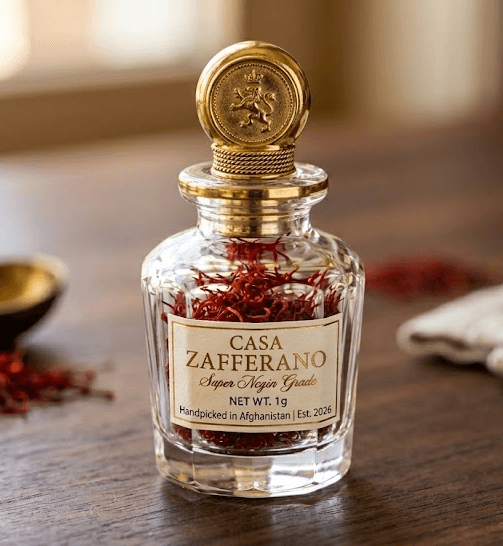
To hold a thread of saffron between your fingers is to hold the product of one of the strangest and most successful plants in the entire agricultural record. Crocus sativus, the saffron crocus, is a sterile triploid hybrid — a plant that cannot reproduce sexually, that produces no viable seeds, and that has depended entirely on human hands for propagation for over three thousand years. Every saffron flower blooming today in Herat, Kashmir, La Mancha, or Mund descends through an unbroken chain of vegetative cuttings stretching back to a single ancestral cultivar that emerged sometime during the Bronze Age. Understanding the unusual biology of this plant is the key to understanding why saffron is so expensive, why it can never be fully mechanized, and why its threads carry such an intense and irreplaceable concentration of bioactive compounds.
The Triploid Mystery: A Plant with Three Sets of Chromosomes
Most plants are diploid, carrying two complete sets of chromosomes — one from each parent. Crocus sativus is triploid, with three sets of chromosomes. This unusual genetic configuration means that during meiosis (the cell division that produces sex cells), the chromosomes cannot pair evenly, and the resulting pollen and ovules are functionally sterile. The flowers produce no viable seeds, and the species cannot reproduce through traditional pollination. The leading scientific theory is that Crocus sativus originated as a chance hybrid between two wild ancestor species — likely Crocus cartwrightianus and possibly a second related species — in the eastern Mediterranean or southwest Asia during the Late Bronze Age, perhaps around 1500 BCE. Early human cultivators noticed and propagated this remarkable plant for its dramatic crimson stigmas, and every saffron crocus on Earth today is essentially a vegetative clone of that original hybrid.
Anatomy of the Flower: Three Stigmas, Three Styles
Each Crocus sativus flower produces a single pistil — the female reproductive structure — that divides into three branches. Each branch consists of a thin, pale yellow style topped by a thicker, deeply crimson stigma. The stigmas are the part harvested as saffron; the styles, which sit just below them, contain little of the active compounds and are typically trimmed away during processing. A single flower thus yields exactly three saffron threads, and a single thread typically weighs just one to two milligrams when dried. This is the fundamental arithmetic of saffron's expense: producing a single gram of dried saffron requires the stigmas of roughly 150 to 200 flowers, all of which must be harvested by hand on the morning they bloom.
The Corm: Saffron's Underground Storage Organ
Below ground, the Crocus sativus plant grows from a corm — a swollen, bulb-like underground stem that stores starch and nutrients to fuel each year's flowering. The corm is the unit of propagation: each summer, after the flowers and leaves have died back, the original corm is replaced by several daughter corms that grow as offshoots from the parent. Farmers harvest the corms every six to seven years, separate them, and replant them in fresh soil at higher density. A single mother corm can, over the course of a few growing seasons, produce dozens of daughter corms, allowing patient farmers to slowly expand their cultivation area without the option of seed-based propagation. The corm itself is roughly the size of a walnut, with a tough brown husk and a pale white interior.
The Autumn Flowering Cycle
Unlike most flowering plants, the saffron crocus blooms in autumn rather than spring. After spending the hot, dry summer dormant underground, the corm sends up a small cluster of grass-like leaves in early October, followed quickly by the famous purple flowers in late October or early November. The flowers open in the cool early morning and last only a single day; by afternoon they have begun to wilt, and within forty-eight hours they have collapsed entirely. This narrow flowering window — combined with the requirement that the stigmas be harvested before the morning sun fully opens the petals — creates the dawn harvesting tradition that has defined saffron production for millennia. After the flowers have finished, the leaves continue photosynthesizing through the winter, building up the corm's energy reserves for the following year's bloom.
Why Mechanization Has Never Worked
Many agricultural research programs have attempted to mechanize saffron production over the past century, and all have essentially failed. The reasons are rooted in the plant's biology: the flowers bloom at slightly different times across a single field, the petals are extremely fragile, the stigmas must be separated cleanly from the styles without damage, and the narrow harvest window cannot accommodate the slower pace of mechanical harvesting. Robotic and computer-vision approaches have made some progress in laboratory settings but remain commercially impractical. As a result, the harvesting and trimming of saffron remains overwhelmingly a human endeavor — and the price you pay for premium A+ Super Negin saffron reflects the patient, skilled hands that have processed every thread from field to airtight glass jar.
Published by Vikram Taneja
More from the Journal

Apr 09, 2026
Moroccan Tagine and Saffron: The Slow-Cooked Soul of North African Cuisine
Inside the conical clay vessels of Marrakech and Fez, saffron meets preserved lemon, ginger, and slow-simmered meat to define one of the world's great cuisines.

Apr 08, 2026
Uzbek Plov: The Saffron-Crowned Centerpiece of Central Asian Hospitality
From Samarkand to Tashkent, the cast-iron kazan and the saffron-perfumed plov define a culinary tradition that has fed Silk Road travelers for over a thousand years.